Projects

Course Projects

Machine learning for medical imaging and diagnosis

Course ProjectMedical ImagingEnsemble Learning

Advancing Skin Lesion Classification with Cross-Validated Ensemble Learning

CSE 4872: Neural Network and Fuzzy System Lab (Spring 2022), extended with stratified five-fold cross-validation

  • Evaluated seven deep-learning models and a soft-voting ensemble for seven-class classification using the HAM10000 dataset of 10,015 dermatoscopic images.
  • Compared SwAV, Inception-v3, ResNeXt-50, two ResNeXt-101 variants, EfficientNet-B5, and DenseNet-121 using stratified five-fold cross-validation.
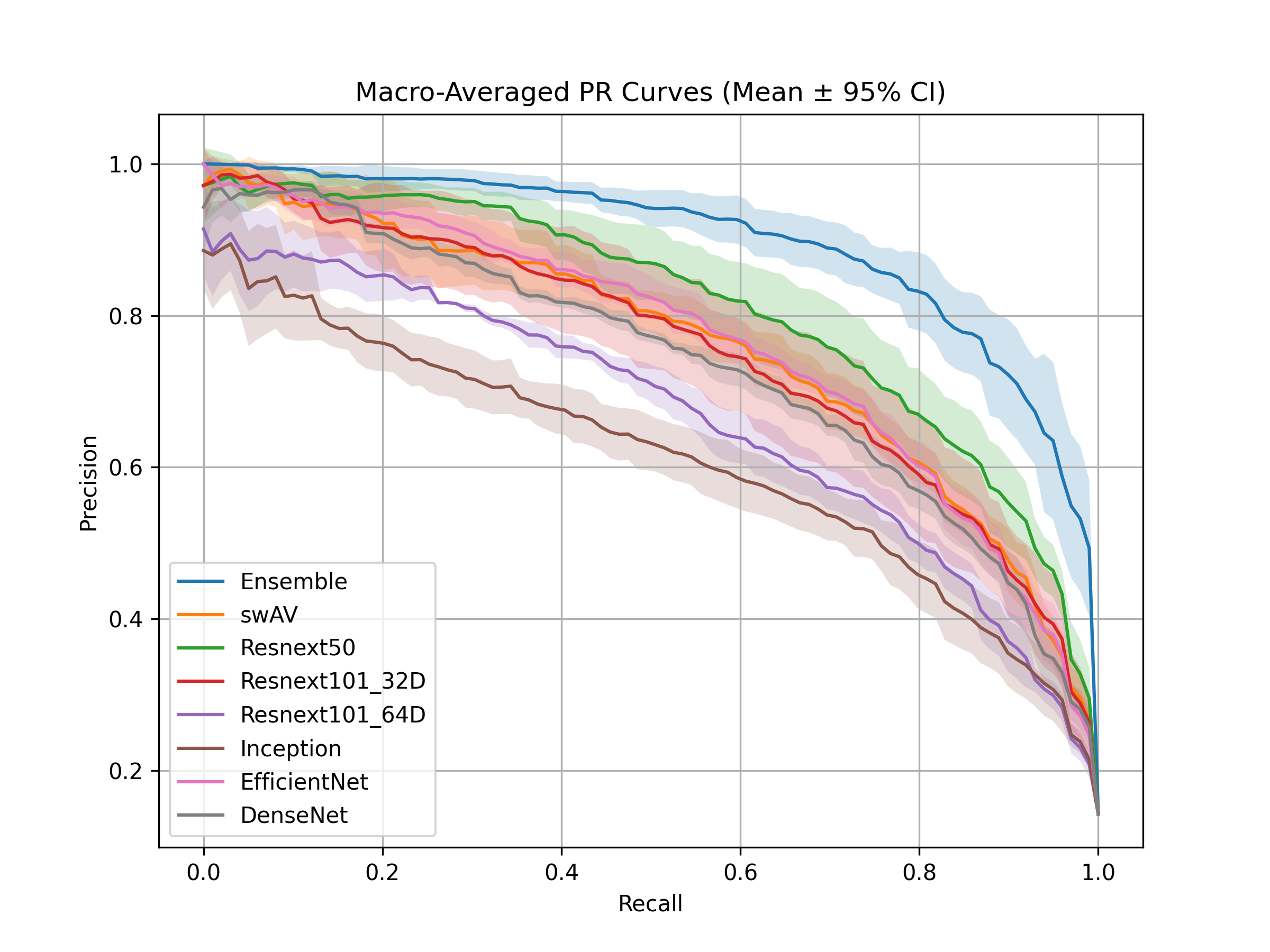
  • The ensemble achieved the best mean scores across all four reported metrics: accuracy 0.8622, macro-F1 0.7324, ROC-AUC 0.9871, and PR-AUC 0.8955.
  • Frameworks/Tools: PyTorch, torchvision, timm, scikit-learn, Matplotlib, Plotly, Weights & Biases, and OpenCV.
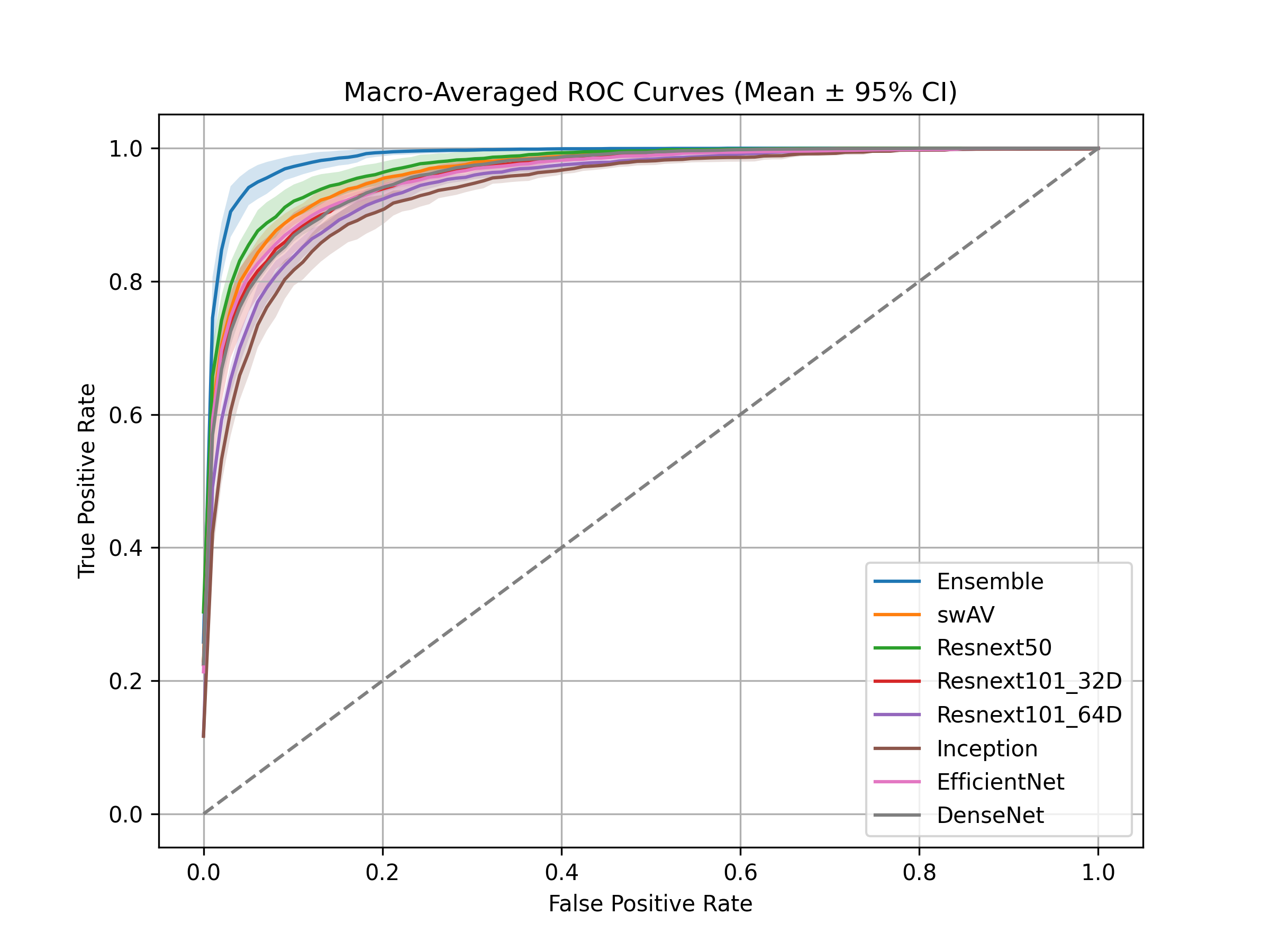
Macro-averaged ROC curves for the ensemble and individual models across five folds.
Macro-averaged ROC curves
Macro-averaged precision-recall curves for the ensemble and individual models across five folds.
Macro-averaged precision-recall curves
Course ProjectMedical ImagingTabular ML

Breast Cancer Detection Using Convolutional Neural Network and Machine Learning Algorithms

CSE 4878: Machine Learning and Data Mining Lab (Spring 2022)

  • Analyzed datasets from two different sources:
    • Breast Cancer Wisconsin (Diagnostic) Dataset [Modality: Structured (tabular)] — Contains features extracted from digitized images of fine needle aspirates (FNA) of breast masses. These features describe the characteristics of the cell nuclei present in the images.
    • Breast Histopathology Images Dataset [Modality: Image] — Comprises image patches of Invasive Ductal Carcinoma (IDC), the most common subtype of breast cancer.
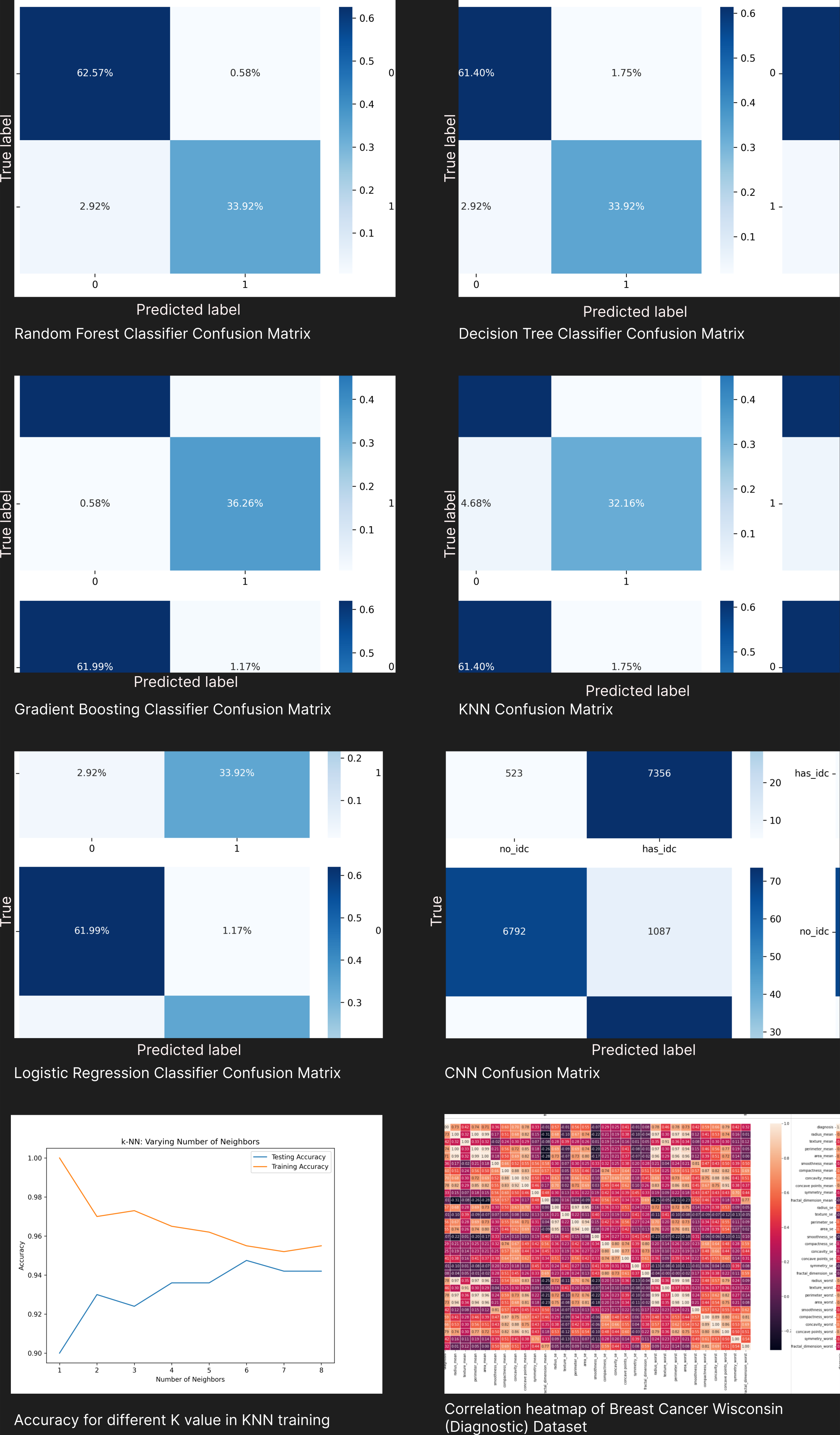
  • Malignant vs. Benign Classification: Preprocessed the Breast Cancer Wisconsin (Diagnostic) dataset by handling missing values, removing highly correlated features, and applying feature scaling. Trained models using Logistic Regression, K-Nearest Neighbors, Decision Tree, Random Forest, and Gradient Boosting classifiers, then ranked their performance based on classification scores.
  • Ductal Carcinoma (IDC) Detection: Downsampled the dataset to handle class imbalance and developed a Convolutional Neural Network (CNN), which was fine-tuned for the IDC classification task.
  • Frameworks/Tools Used: TensorFlow, scikit-learn, Pandas, NumPy, Matplotlib, Seaborn, and OpenCV.
Some figures from the project.
Some figures from the project